Black Friday is Friday 27 November 2026 and Cyber Monday is Monday 30 November 2026. Between Wednesday 18 November and Thursday 19 November, WordPress, nginx and PHP each published a security release — in the same week that some hosts temporarily turned HTTP/2 off.
A change freeze is not a reason to ignore that, and it is not a reason to patch blindly either. The useful work this week is the same at every layer.
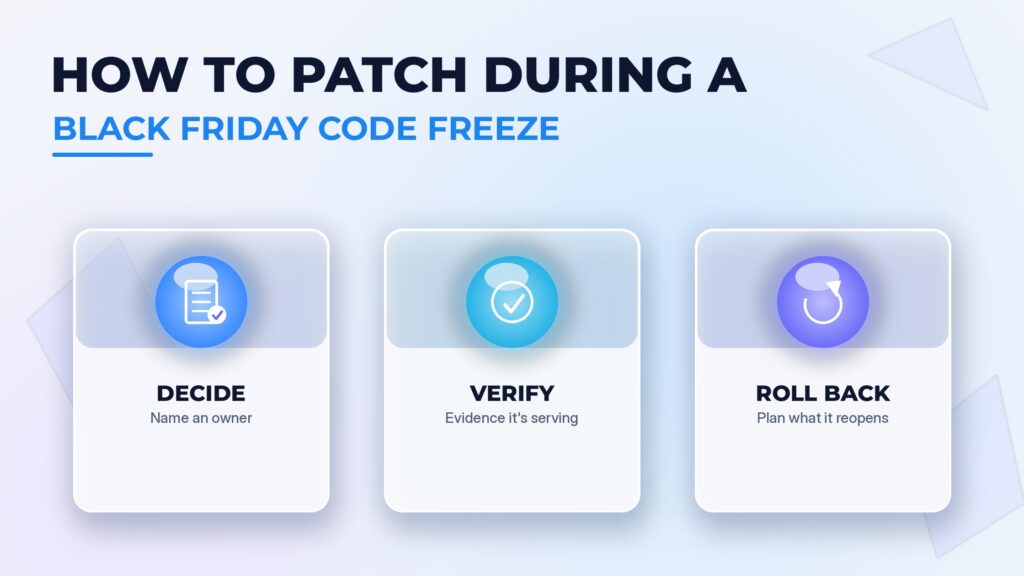
In short: I’d treat WordPress, nginx and PHP as three examples of one mid-freeze decision, not three different kinds of ticket. Status belongs to the issue or fix being assessed, not to the layer as a whole. For each issue, record whether it is fixed, mitigated, still exposed, out of scope, or not yet verified, and what evidence supports that. Disabling HTTP/2 can reduce the reach of two nginx HTTP/2 flaws while you wait for a fixed build, but it is not a complete nginx fix, it can have a performance and compatibility cost, and it does nothing for the WordPress or PHP releases. Before peak, every security exception needs an owner, evidence that the fix is serving traffic, and a recovery plan that accounts for what it could reopen. Everything below is as I read the primary sources on Saturday 21 November 2026.
Decide, verify, roll back
WordPress 7.1.5, nginx’s 18 November builds and the PHP security releases on the 8.2–8.5 maintenance branches are three cases of that same decision.
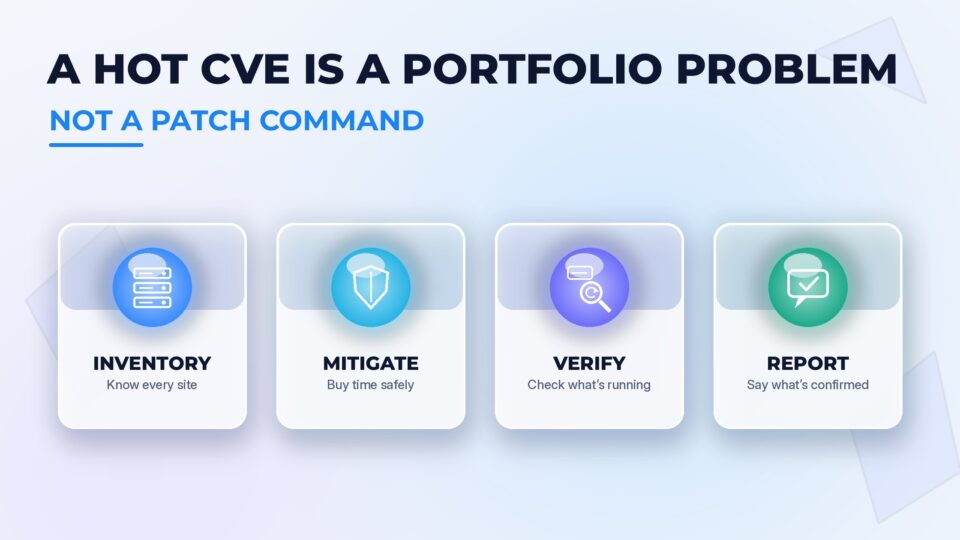
If you look after one server and the packages are already in, this can be a short change window. If you look after a portfolio, across hosts, control panels and owners, the harder part is knowing which layer has actually moved, especially when a host has mitigated rather than patched, or has backported a fix without changing the visible version number. I wrote about that verification problem in October for PHP2Shell; the point still applies, and this week it applies to three layers at once, inside a freeze.
I’d want a written exception path before anyone needs it: who can approve a security update or a protocol change during the freeze, what will be checked before and after, and who can roll it back. For each site, record a status for each issue or fix in the release being assessed, rather than one status for the whole layer:
- the running WordPress version, and whether 7.1.5 or a shipped backport for that branch is actually in place
- the nginx build or package, and whether HTTP/2 is enabled on the listener that faces the origin, not only in a file on disk
- the PHP branch and the package that serves web requests, and whether the front end reuses FastCGI connections to PHP-FPM
- who is allowed to change each of those, and who needs to be told
Then label what you know, for each issue:
- Fixed means a fixed build is running and the workers that served the old one have been replaced.
- Mitigated means a temporary control is in place for that issue while you still need the vendor build. If HTTP/2 was switched off in response, record the two nginx HTTP/2 issues as mitigated, not as out of scope. The same applies if you disabled FastCGI connection reuse in response to CVE-2026-129289.
- Still exposed means you have verified the system is vulnerable to that issue and you have not yet patched or mitigated it.
- Out of scope means you have checked, and can show, that the relevant condition is not present for that issue. If nginx never offered HTTP/2 on the affected listener, CVE-2026-123007 and CVE-2026-123633 may be out of scope, while other fixes from the same 18 November release can still be pending.
- Not yet verified means the version string, the host dashboard or the config file has not been checked against the process that is actually serving traffic.
A backported nginx or PHP package can be fixed without looking like 1.30.7, 1.31.9 or 8.5.13; until that backport is confirmed, I’d keep those issues as not yet verified.
WordPress released 7.1.5 on 18 November and recommended that sites be updated immediately, including through automatic background updates where they are enabled. Security builds have also shipped for some older branches, including 7.0.9 and 6.9.12, both dated 18 November in the release archive. The 7.1.5 announcement, as I read it on 21 November, still said backports were in progress, so I’d check the archive and the applicable advisories for the branch you run rather than relying on that wording alone. The release fixes multiple issues. One of them is an unauthenticated privilege-escalation issue in Template Part block attributes that, in WordPress’s words, “could lead to remote code execution”. The advisory lists 7.1.5, 7.0.9 and 6.9.12 among the patched versions for that issue. For closure, I’d verify the installed WordPress core version and Site Health, not only that an update job has been queued.
On 18 November, nginx published vulnerability fixes in stable 1.30.7 and mainline 1.31.9. Two of the issues are in HTTP/2: CVE-2026-123007, which nginx describes as memory corruption in HTTP/2 flow control, rated major, and CVE-2026-123633, a use-after-free in HTTP/2, rated medium. The same builds also fix other issues, including a use-after-free in HTTP/3, a use-after-free in the mail proxy module, and a use-after-free in the resolver. Disabling HTTP/2 can mitigate the two HTTP/2 issues; it leaves those other fixes outstanding. CERT-FR and CERT-EU both describe a risk of unauthenticated code execution in the nginx worker. CERT-EU wrote on 18 November that researchers had demonstrated CVE-2026-123007 and that, at that time, no exploitation in the wild had been reported. CERT-FR wrote the same day that it was aware of a public proof of concept for that CVE. That is not the same as confirmed exploitation. The Canadian Centre for Cyber Security, in an 18 November alert, listed NGINX Plus builds prior to 37.3.0.1, 37.0.8.1, 37.2.0.1 and 37.0.7.1, and Open Source builds prior to 1.31.9 and 1.30.7.
The complete nginx fix is a build that includes those 18 November fixes — stable 1.30.7, mainline 1.31.9, the equivalent NGINX Plus release, or your distribution’s backport — and evidence that the fixed build is serving traffic. A configuration reload can start new workers from the existing nginx executable. After a package update, verify that the fixed executable is serving traffic and that workers from the old build have stopped serving requests. nginx’s own documentation also says that after a graceful reload, old worker processes close listen sockets and continue to service existing clients until those clients are finished, so I would not stop at a successful reload command. When a CDN or load balancer terminates HTTP/2, a public browser check may describe only that edge. The relevant check is the nginx listener itself.
On Thursday 19 November, PHP published security releases for the 8.2–8.5 maintenance branches: 8.5.13, 8.4.28, 8.3.37 and 8.2.36. Each announcement calls it a security release and encourages or advises users on that branch to upgrade. PHP 8.6.0 also went GA on the same day. The day before, on 18 November, the PHP security team had warned that the highest severity was critical, and that “the issues rated CRITICAL require either non-default configuration or uncommon setups.”
The 8.5.13 changelog lists CVE fixes across the engine, CGI, PHP-FPM, session handling and other components. Several are described as able to lead to remote code execution. One that matters for some PHP-FPM deployments is CVE-2026-129289, PHP-FPM request smuggling through an unread HTTP request body, published on 19 November and rated Critical. The official advisory says exploitation requires a front end that reuses persistent backend connections and an application path that opens php://input without reading it fully. It names nginx with fastcgi_keep_conn on as one such configuration, and it is explicit that standard nginx and Apache configurations that close the FastCGI connection after each request are not affected by the demonstrated attack. Until a fixed PHP build is installed, the official temporary mitigation is to leave fastcgi_keep_conn disabled, or otherwise close the backend connection after every request. That mitigation is only for this issue. It does not stand in for the rest of the 19 November PHP fixes. Those releases also fix CVE-2026-115560, the narrower session-serializer issue that PHP flagged in October and said it would detail with the next regular release. For closure, I’d verify that the fixed PHP build is the one serving requests, and that workers started before the update have been replaced.
Before the change, name the rollback owner and agree what would trigger recovery. If recovery restores a vulnerable build or configuration, record the site as exposed again, reinstate any applicable temporary control, and set a deadline for the fixed build. A successful rollback can still leave work open. In peak traffic, that recovery plan wants to be agreed before anyone needs it, not invented during checkout problems.
Patch versus turning HTTP/2 off
Until a fixed nginx build is available, CERT-FR recommended disabling HTTP/2. CERT-EU said the same as a temporary measure, and was specific that it mitigates CVE-2026-123007 and CVE-2026-123633. On nginx 1.25.1 and later, the usual temporary change is to set http2 off; in the affected http or server context and to remove any http2 parameter from listen directives. On older versions, the http2 directive is not available, so the parameter has to come off the listen line. I’d still confirm that old workers have exited, and I’d check the nginx listener, not only what a browser sees in front of a CDN.
That is also what some hosts did. On 18 November, Combell said that for systems where no patch was available yet, it had disabled HTTP/2 as a precaution, and that browsers would fall back to HTTP/1.1. On 19 November, Combell reported that it had rolled out the patch on its shared web hosting, reseller hosting, and Managed WordPress and WooCommerce services. As I read that page on 21 November, that remained the latest update. None of this is a picture of every host, and it is not a statement about any particular client’s server.
The trade-off is real, and it is not the same for every site. Browsers typically fall back to HTTP/1.1, and HTTPS itself stays on. Combell said there was no noticeable impact on availability. Applications that require HTTP/2, including some gRPC services, may fail until the protocol is re-enabled. In peak week, that is a reason to test checkout, account and asset-heavy pages after the change, not a reason to assume the cost is either zero or severe.
And it is only a partial mitigation. HTTP/2 off can close the two HTTP/2 paths above. It does not patch nginx, it does not cover the HTTP/3, mail-proxy or resolver issues in the same release, and it does not address WordPress 7.1.5 or this week’s PHP fixes. I’d re-enable HTTP/2 only after a fixed nginx build is installed and the running workers have been confirmed, not leave the protocol off as a stand-in for the patch.
Before Friday 27 November
These are the questions I’d want answered this week:
- Do we know the running WordPress, nginx and PHP builds, and whether HTTP/2 is actually offered on the nginx listener?
- For each layer, which issues are fixed, mitigated, still exposed or out of scope, and what evidence supports that?
- If HTTP/2 is off, is that a temporary mitigation with an owner and a plan to re-enable it after a fixed nginx build is confirmed?
- If we still need to change something before Black Friday, who owns the exception, how will we prove the fix is serving traffic, and what is the recovery plan if we have to roll it back?
- Have the people who own each site heard what is confirmed, and what is still outstanding?
Installing a security release is only one part of the job. The rest, especially in a freeze, is being able to say which issues are fixed, mitigated, still exposed or out of scope, what evidence supports that, and what you have not yet verified.
Sources and further reading
- WordPress 7.1.5 Release (18 November 2026)
- WordPress release archive
- WordPress GitHub advisory GHSA-pmp8-6cv8-q323 (18 November 2026)
- nginx news: 2026 (18 November 2026 entry)
- nginx security advisories
- Controlling nginx
- CVE-2026-123007 and CVE-2026-123633
- Canadian Centre for Cyber Security, AV26-1174 (18 November 2026)
- CERT-FR, CERTFR-2026-ALE-017 (18 November 2026)
- CERT-EU, 2026-022 (18 November 2026)
- PHP: Upcoming Critical PHP Security Release (18 November 2026)
- PHP 8.6.0, 8.5.13, 8.4.28, 8.3.37 and 8.2.36 announcements (19 November 2026)
- PHP 8 changelog
- PHP advisory GHSA-qc49-hpvq-g2w6, CVE-2026-129289 (19 November 2026)
- Combell: Various Security Vulnerabilities in Nginx