On 21 October 2026, security fixes arrived for two widely used components: PHP and Brotli. PHP shipped fixes for the two remote code execution vulnerabilities now known as PHP2Shell, which I wrote about on 27 October. Google released Brotli 1.2.1 to fix a flaw in the decoder of its widely used compression library. For teams running affected software, both demanded assessment and remediation—whether or not that work appeared on the roadmap.
That’s normal. Every ecommerce team loses capacity to work that was never on the roadmap: security patches, platform and API deprecations, dependency upgrades and the clean-up after peak. The question isn’t whether that work will turn up in 2027. It’s whether your plan admits it will.
In short: Unplanned maintenance is predictable in total, even if each item isn’t. If it isn’t budgeted, it either quietly eats feature delivery or gets skipped until it becomes an incident. As you set 2027 roadmaps this November, size maintenance from the last 12 months of real data, checked against 2026 year to date, give it its own protected line on the roadmap, and report on it the same way you report on features.
Two reminders from October
PHP2Shell was the loud one: a critical fix to the runtime itself, with a clear version to install. I covered the portfolio side of it in my last Insight, so I won’t repeat it here.
Brotli is the quieter, and in some ways more instructive, example. CVE-2026-111497 is an out-of-bounds write in the Brotli decoder in versions 1.0.3 to 1.2.0, fixed in 1.0.10, 1.1.1 and 1.2.1. Ubuntu lists fixed Brotli packages for supported releases, with some older releases requiring Ubuntu Pro.
What makes it a good roadmap lesson is where Brotli lives. It’s a low-level library most teams never chose directly. It ships inside runtimes and tools—Microsoft’s guidance covers common stacks such as .NET, Node.js and PHP’s Windows builds—and on Linux it may come from a shared system package or be bundled inside another product.
PHP’s own notice explains that in its Windows builds the decoder can be reached through the cURL extension when automatic response decompression is switched on. That’s off by default, but applications and HTTP client libraries can enable it. Microsoft also points out that a web application firewall only inspects inbound requests, so software that fetches and decompresses responses from other servers still needs patching. A store that pulls in remote data, such as supplier feeds, may be decoding Brotli without anyone having written a line of code that mentions it.
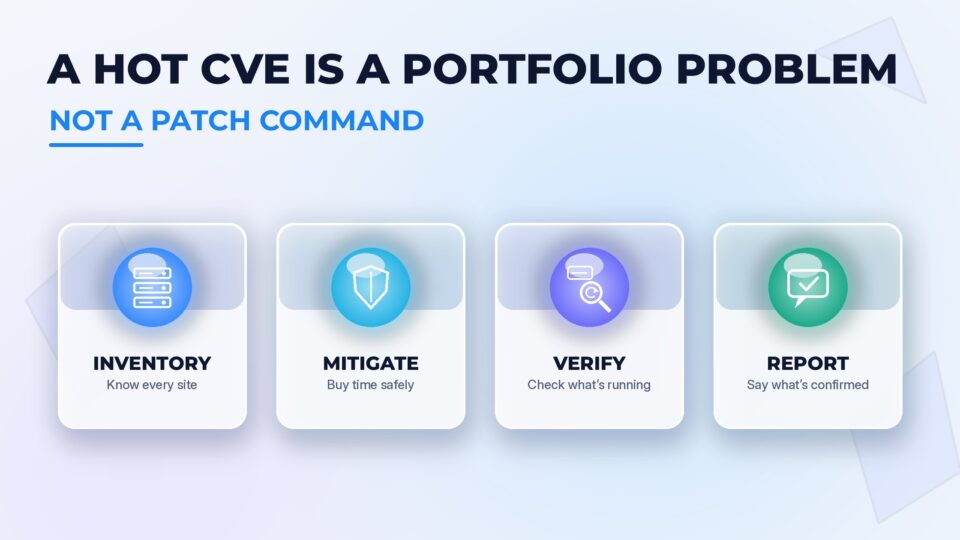
So the work wasn’t “upgrade Brotli”. It was: find out which servers have the library, at what version and from which package source, decide whether each is exposed, patch, restart the services that load it, and confirm. Where the library is bundled, update the containing product or rebuild and redeploy the application or container; updating the host’s shared library may leave that copy untouched. Across a portfolio, that’s a small project, and it arrived with no warning.
Why it doesn’t get planned
None of this is negligence. Roadmaps are built from things people can name in advance. Some maintenance has a known deadline. Other work arrives without a date you can plan around. Both need capacity. Individually, each item looks like an interruption. Collectively, it’s one of the most reliable workloads a team has.
When there’s no line for it, one of two things happens. Either it’s absorbed silently, features slip, and nobody can explain why the quarter felt slower than planned. Or it’s deferred: the upgrade waits for a quieter month, the deprecation waits until the deadline, and a routine job turns into an urgent one. Black Friday makes the second pattern worse, because change freezes push upgrades back to January, which is exactly when 2027 delivery is meant to start.
Step one: size it from the last 12 months
You don’t need to predict which CVE will land in March. You need a realistic total. Start with your own delivery history; use benchmarks only as a sense-check:
- Go through tickets, incidents and pull requests from the last 12 months, checked against 2026 year to date, and tag the work that was security patching, platform or API deprecation, dependency upgrades or post-peak clean-up.
- Estimate the share of engineering time it took, quarter by quarter. Expect it to be lumpy, with spikes after peak and around major platform releases.
- Separate recurring demand from one-off migrations, include coordination and verification time, and avoid adding known upgrades twice if they’re already represented in the baseline.
- Add what you already know is coming: end-of-life dates for your runtime and framework versions, announced API deprecations from your platform and payment providers, and certificates or contracts that expire.
If you didn’t track it, that’s the first finding, and a reason to start tagging it now.
Step two: give it its own protected line
Put maintenance on the roadmap as a named line with capacity against it, not as a buffer hidden inside feature estimates. Hidden buffers get spent on features the moment a deadline gets tight.
“Protected” means it doesn’t get raided to rescue a feature without a deliberate decision by whoever owns the roadmap. Where something urgent like Brotli lands, it draws down that line first, and the trade-off is visible rather than silent.
If urgent work exceeds the allocation, explicitly replan feature commitments. The maintenance line is a forecast, not a reason to delay a critical fix.
Plan the known, post-peak work explicitly too. Book January windows for work that can safely wait, with named owners, rather than deferring everything until after Black Friday; critical security fixes need an exception route through the freeze.
Step three: report it like features
Maintenance only stays funded if people can see what it bought. Report it alongside feature delivery:
- what was done: patches applied, versions retired, deprecations cleared
- how quickly critical fixes were verified across every site or server
- what’s still outstanding, and the risk of leaving it
- planned versus actual capacity, so next year’s sizing improves
That turns “engineering was busy with other things” into a clear account of risk reduced.
A checklist for your 2027 planning
- Have we measured how much time maintenance took in the last 12 months, checked against 2026 year to date, from our own tickets?
- Is there a named, sized maintenance line on the 2027 roadmap?
- Is it protected from being raided for features without an explicit decision?
- Do we know our end-of-life dates and announced deprecations for 2027?
- Is the post-peak upgrade window booked, with owners?
- Do we have an inventory good enough to answer “where do we run this library?” within a day?
- Will maintenance appear in the same reports as features?
A caveat: the right share of capacity varies a lot by stack, age of codebase and how much you host yourselves, which is why I’d size it from your own data rather than a rule of thumb.
You don’t need to know the next vulnerability to reserve capacity for responding to it.
Sources and further reading
- NVD: CVE-2026-111497 (Brotli)
- Google Brotli v1.2.1 release (21 Oct 2026)
- Ubuntu: CVE-2026-111497 (Brotli)
- MSRC: Patch now: PHP2Shell, Brotli, and eMudhra guidance for customers (30 Oct 2026)
- GitHub advisory GHSA-9v8h-qqgm-4m35 (Brotli)
- PHP news archive 2026: PHP2Shell advisory and Brotli Windows builds (php.net)