Black Friday is Friday 27 November 2026 and Cyber Monday is Monday 30 November 2026. In the first week of December, someone will open the peak report and ask whether a change in organic search was an SEO problem.
This year that question is harder to answer from the dashboard alone, because an AI shopper doesn’t always look like one. Some shoppers are choosing products in AI assistants. Their visits can arrive looking like search or direct traffic. The agents working for them can read your pages without appearing in analytics. And on some AI channels the checkout happens inside the assistant, where your analytics tag never runs.
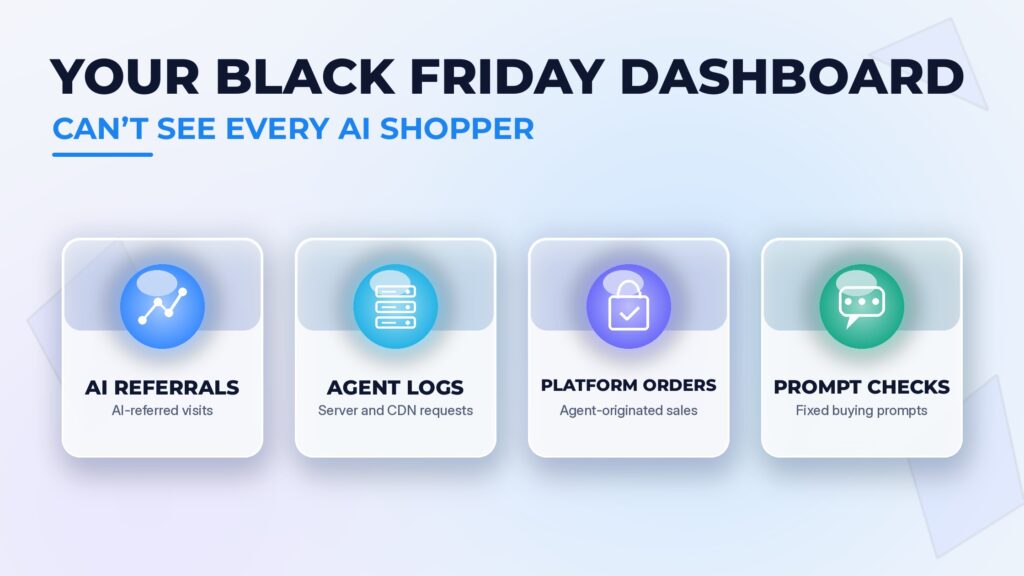
In short: I’d set a baseline in the ten days before Black Friday from four sources side by side: AI-referred visits in analytics, agent requests in server, CDN or WAF logs, agent-originated orders in the platform’s own order and channel reports, and whether assistants recommend you for a fixed set of buying prompts. Then the post-peak review can say plainly what was measured, what was estimated and what still couldn’t be seen. Features, eligibility and defaults vary by country, plan and platform and may change; everything below is as I read the primary sources on 16 November 2026.
Why the organic line needs context this year
ThoughtMetric, an attribution vendor, published an analysis last updated on 11 November 2026 of combined Google organic visits across 200 ecommerce brands that use its product. September and October 2026 both came in 20% below the January to August monthly average, and ThoughtMetric says the drop lines up with changes to Google’s AI Overviews from late August. This is an aggregate comparison with earlier months, not a year-on-year or seasonally adjusted estimate, and the timing alone doesn’t establish that AI caused the decline. It also makes the point that a fall in organic sessions doesn’t necessarily mean demand fell, because some of those shoppers come back later through a direct visit or a paid ad. That’s one vendor’s customer base, not the whole market, but it’s a clear prompt to check your own numbers before November’s.
On 12 November 2026 the IAB released its AI-Era Attribution Blueprint. Its announcement puts the problem directly: “AI-influenced sales are sometimes reported as search or direct traffic, which can send the next marketing investment to the wrong channel.” The same release cites the IAB’s 2026 Outlook Study: September Update, in which 44% of ad buyers said they rely on branded search and direct traffic as proxies for AI influence they can’t track.
Where AI shoppers drop out of the report
There are three gaps, and they need different fixes.
- Influenced visits arrive as search or direct. Google Analytics added an AI Assistant channel on 13 May 2026. According to its default channel definitions, GA4 assigns the channel when the medium is ai-assistant; it sets that medium automatically for recognised AI referrers. The same definitions say that AI Assistant “excludes Google’s AI Overviews and AI Mode”, which count as Organic Search. A shopper who reads an assistant’s answer and later types your address, or searches for your brand, arrives as Direct or Organic Search.
- Agent fetches don’t reach analytics. An assistant that reads a page on a shopper’s behalf can identify itself in the request; OpenAI, for example, documents a ChatGPT-User agent that “may visit a web page” when a user asks a question. Google Analytics automatically excludes traffic from known bots and spiders, and you can’t disable that or see how much was excluded. So a request that GA4 recognises as a bot isn’t in your reports, and one that doesn’t run your page’s JavaScript never sends the tag in the first place. Either way, analytics isn’t the place to count agent visits.
- Some checkouts happen inside the assistant. Shopify’s agentic storefronts are active by default for eligible stores. For Google AI Mode and Gemini, Microsoft Copilot and Meta, direct checkout is on by default for eligible stores, and Shopify says the same thing on each page: “Google Analytics and custom pixels won’t fire” in that channel’s direct checkout, which “fires only server-to-server pixels (started, completed)”. The order still lands in your Shopify admin with channel or referrer attribution. ChatGPT is different: Shopify describes it as a discovery-focused referrer, and the shopper buys on your own online store checkout.
Whether the third gap applies to you depends on where you sell. As of 16 November 2026, Shopify lists the United States, Canada and Australia for Google’s direct checkout, the United States for Copilot, and a list of countries for Meta that includes the United Kingdom.
Four sources for a baseline before 27 November
None of these is complete on its own. Together, they help you investigate whether demand changed, whether its route changed, or whether measurement changed.
- AI-referred visits. In GA4, record sessions, revenue and conversion rate for the AI Assistant channel, alongside Organic Search and Direct. On Shopify, the Agentic section reports online store sessions and conversion per AI channel. Shopify says these performance analytics aren’t yet available for headless stores. Treat these as counts of attributable visits, not a complete count of AI-influenced shoppers.
- Agent requests in server, CDN or WAF logs. If you run a headless front end, or your own CDN or WAF in front of the store, count requests by AI user agent each day and keep them separate by purpose. Cloudflare’s bot reference, for example, puts ChatGPT-User, Claude-User and Perplexity-User in an “AI Assistant” category, apart from training crawlers and AI search bots. User-triggered fetches are the closest thing logs offer to a shopper’s agent reading your product pages. Count these as requests, not shoppers or purchases. A user-triggered fetch doesn’t establish shopping intent, and cached or feed-based discovery may generate no request to your storefront. User agents can be spoofed, so rely on verified-bot signals or published IP ranges where your provider offers them.
- Agent-originated orders in the platform’s own reports. On Shopify, Sales channels > Agentic reports sales and orders for each AI channel, and Shopify notes that the sales figure combines referral-based sales and direct-checkout sales. Orders placed in Meta’s Muse show Meta AI and Muse as the sales channel. This is the source for the checkouts your pixels can’t see. A platform order is observed evidence, but its channel attribution still follows the platform’s rules, and it doesn’t prove incremental AI-generated demand.
- Whether assistants recommend you. Write a fixed set of buying prompts now, the questions your customers might ask an assistant in your category before Black Friday. Run the same prompts in the same assistants each week, and record whether you’re named and whether you’re linked. Record the country, the account state (for example signed in or out), the assistant and model, and repeat each prompt several times, because answers vary between runs and users. The result is a small, controlled visibility sample. Shopify’s search preview in the Agentic section is useful alongside it, and Shopify itself calls that preview “a directional signal, not an exact prediction”. If you’ve claimed your business profile, the ChatGPT Business Hub also shows how often ChatGPT mentions your business.
These sources overlap; don’t add their totals together. Reconcile identifiable orders by order ID where available, align reporting periods and revenue definitions, and document differences in attribution.
Capture the same figures for the same days each week, starting now, so you have at least one full week before Black Friday to set against peak week. Treat that week as operational context for reading peak, not a benchmark for normal demand. Alongside it, record promotion dates, tracking changes and comparable prior-year trading periods where available.
Measured, estimated and can’t see
The point of the baseline is a post-peak review that’s honest about its own limits. I’d split it into three columns.
- Measured. Orders and revenue from the platform’s own order and channel reports, including direct-checkout orders. Visits that GA4 or Shopify attributed to an AI channel. Agent requests in your logs, where you have them.
- Estimated. How much of a change in organic and direct traffic was AI-influenced. Any estimate of AI’s contribution needs an explicit method and assumptions. Changes in organic traffic, direct traffic and revenue provide context; they don’t establish how much AI caused. Label it as an estimate and say how you made it. “Not estimable from the available evidence” is a valid result.
- Can’t see. Shoppers who read an assistant’s answer and never clicked or bought. Agent visits where you have no logs. Recommendations in assistants and prompts you didn’t check.
That third column isn’t a failure of the analytics team. It’s where the evidence currently sits, and the IAB’s blueprint says much the same about the industry as a whole. Writing it down stops a fall in organic traffic being blamed on SEO by default, and stops an estimate being repeated as a measurement in next year’s plan.
A checklist for the next ten days
- Is the AI Assistant channel in this year’s peak dashboard, next to Organic Search and Direct, with historical weekly figures where available?
- Do we know which AI channels we sell on, and whether direct checkout is on for each of them?
- Does the peak report reconcile platform orders against analytics, by order ID where available, so direct-checkout orders aren’t missing and nothing is counted twice?
- If we have server, CDN or WAF logs, are we counting AI assistant requests separately from training crawlers and search bots?
- Have we written a fixed set of buying prompts and recorded the first results before Friday 27 November 2026?
- Does the post-peak review template have separate sections for measured, estimated and can’t see, plus a record of promotion dates and tracking changes?
- Is the person writing the review clear that an organic drop needs this context before anyone draws a conclusion about SEO?
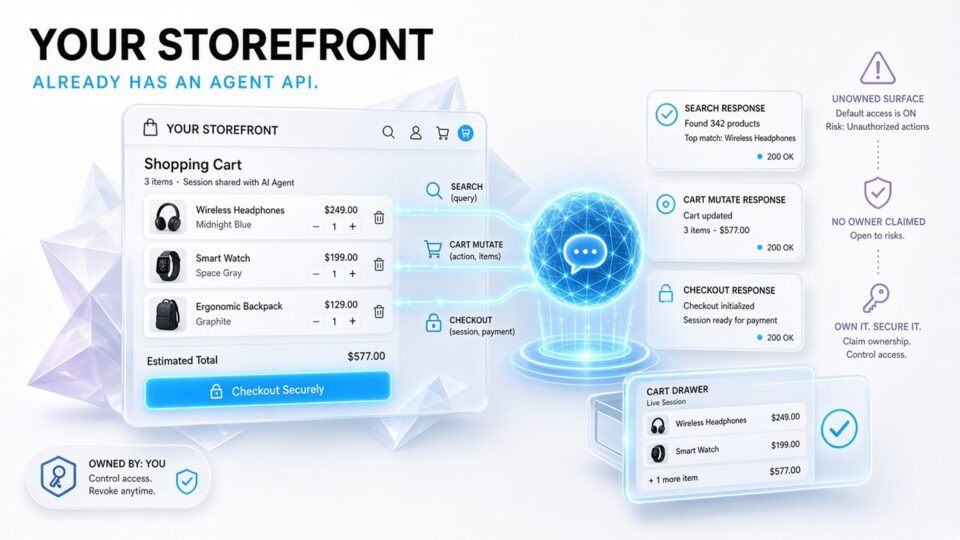
As I wrote on 22 September, your storefront already has an agent API. Peak reporting now needs to account for the shoppers who use it, including the ones the dashboard can’t see.
Sources and further reading
- ThoughtMetric: Google organic traffic for e-commerce stores fell 20% in September and October (updated 11 Nov 2026)
- IAB: IAB releases AI-Era Attribution Blueprint (12 Nov 2026)
- Google Analytics Help: Default channel group
- Google Analytics Help: What’s new (AI Assistant channel, 13 May 2026)
- Google Analytics Help: Known bot-traffic exclusion
- Shopify Help Centre: Shopify agentic storefronts
- Shopify Help Centre: Managing agentic storefronts and performance data
- Shopify Help Centre: Selling on Google AI Mode and Gemini
- Shopify Help Centre: Selling on Microsoft Copilot
- Shopify Help Centre: Selling on Meta
- Shopify Help Centre: Selling on ChatGPT
- OpenAI: Overview of OpenAI crawlers
- Cloudflare AI Crawl Control: Bot reference