On 31 August I argued that agentic commerce fails on storefront basics before protocols matter. That still holds. Reach, readable facts and aligned catalog truth come first.
The argument is incomplete. Platforms are now shipping agent surfaces by default. On Shopify Liquid storefronts, the agent API is not a future integration ticket. It is already on the page.
What Shopify shipped on 5 August
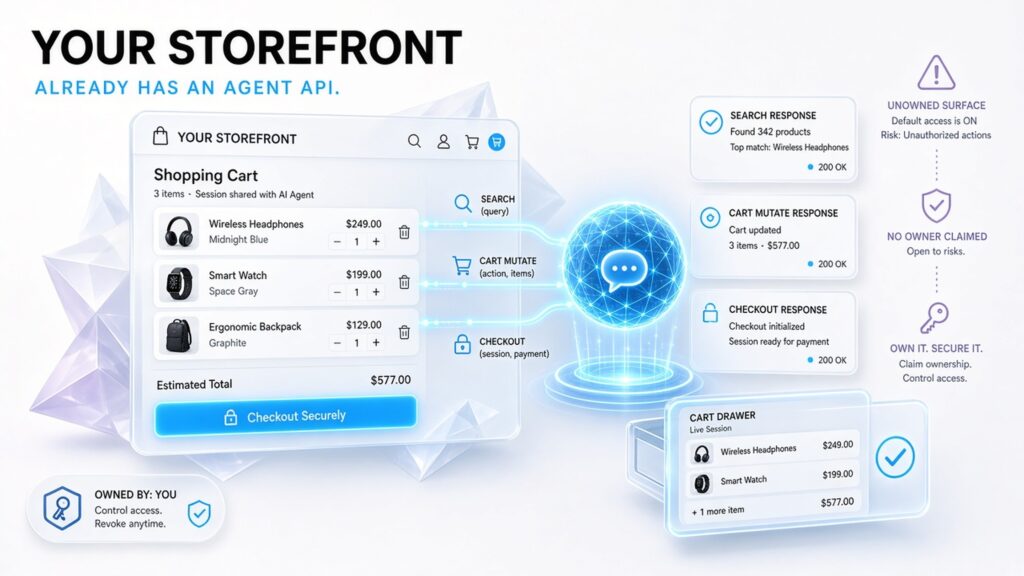
On 5 August 2026, Shopify enabled WebMCP tools on every Liquid storefront, and on the Hydrogen developer preview, with nothing to install or configure. WebMCP is a proposed web standard for registering structured tools with the browser so an agent can call them instead of scraping HTML and simulating clicks.
These browser-facing tools serve agents the shopper brings to the storefront. They are not the same thing as a merchant-owned shopping agent or an external agent connecting through Shopify’s Storefront MCP.
The documented default tools can:
- search and browse the catalog;
- inspect and mutate the shopper’s cart;
- navigate the shopper to checkout;
- navigate an authenticated shopper to order history;
- answer questions from store policies and FAQs.
The documented default tools can change the cart and take the shopper to checkout, but they do not place the order or complete payment.
That list matters more than the acronym. An agent that can search, mutate the cart and send the shopper toward checkout is not a passive reader of your PDP. It is a client of your storefront session.
Shopify’s changelog is explicit about the operating model. Everything the agent does happens in the shopper’s live tab. Cart tools call the same standard storefront actions apps already use, so a theme that opens a cart drawer on update will open it for the agent too. Catalog tools read through the Storefront API. The agent and the human share one cart and one set of navigation side effects.
Browser support remains experimental. Chrome 149 exposes WebMCP through a time-limited origin trial, while Shopify currently describes agent support as limited to Chromium-based browsers. Experimental support is not the same as no surface. Defaults travel faster than browser adoption curves.
Hydrogen is being rebuilt around the same contract
The Hydrogen developer preview, announced earlier in 2026 and updated through the summer, is not a Remix-shaped framework with agent features bolted on. Shopify describes it as a toolkit: framework-agnostic commerce primitives, thin bindings, and agent skills that teach a coding agent how to wire the storefront correctly.
That rebuild matters for leadership for one reason. Hydrogen is aligning headless storefronts with the same standard events and actions Liquid themes already use. The same plumbing that powers a cart drawer is what lets an agent read store state and update the cart. Headless and theme are converging on one commerce contract, not two parallel stories.
In the developer preview, WebMCP loads by default through ShopifyScripts. Teams can opt out with webMcp={false}, or initialise scripts themselves in frameworks without a Hydrogen binding. That explicit control is useful while the surface matures. It is also a reminder: platform defaults create work even when the toggle exists.
Blueprints are arriving beside the storefront tools
On 2 September, Anthropic published a commerce-agent blueprint containing reference implementations for both shopping and merchant agents. Anthropic also names Shopify among the enterprise customers using Claude to build commerce agents.
Treat that as context, not as a reason to pause ownership of the storefront surface. Protocol profiles, MCP servers and vendor blueprints will keep multiplying. The leadership question is narrower: when an agent can act inside the shopper’s session, who owns the blast radius?
This is a platform-default pattern, not a Shopify changelog piece
Adobe is moving in a related, but different, direction. Its Commerce MCP materials describe agent access to catalog, cart and checkout capabilities, although Adobe currently labels the Commerce MCP overview “Coming Soon”. That is evidence of the wider platform direction, not an equivalent default-on browser surface.
When the commerce platform ships an agent-callable surface by default, engineering leadership inherits a new integration class. It arrives without a Jira ticket from marketing, without a vendor onboarding call, and without the usual “shall we add this script?” debate. That is why the ownership model has to look like third-party script governance, even when the code is first-party platform runtime.
Ownership, not protocol tourism
Protocol tourism is learning the latest acronyms while leaving the live cart unowned. Ownership is naming who is accountable when an agent changes the basket a human is staring at.
Treat the agent surface like a third-party script with sharper teeth:
- Named owner. Not “platform”, “digital” or “the agency”. A person who can decide whether the surface stays on, what it may touch, and how incidents are handled.
- Known surface. Document which tools are exposed, on which templates, and which actions mutate cart, checkout or session state — and distinguish browser tools from merchant-owned agents and external integrations.
- Explicit opt-out where it exists. On Hydrogen’s developer preview, that currently includes
webMcp={false}onShopifyScripts. On Liquid Online Store, Shopify’s public docs describe the tools as live with nothing to configure. If your stack has no merchant-facing switch, record that fact: default-on without a kill switch is still an ownership decision. - A pre-peak test. Before Black Friday traffic, exercise what an agent may do on revenue-critical journeys under the same scrutiny you would give a new tag or A/B tool.
This connects to themes already on the leadership agenda. Peak season is an engineering deadline: you do not discover a mutating client for the first time on the Friday morning spike. INP ownership is related for a different reason. Agent actions that share the shopper’s session will exercise the same cart UI, drawers and handlers that human taps already stress. If nobody owns the surface, nobody owns the failure mode. The same is true for third-party script governance: who may introduce main-thread and session cost still belongs with the people who own the commercial outcome.
A pre-peak checklist for engineering leads
Outside the tab, commerce protocols such as UCP and ACP, and tool interfaces built with MCP, address different integration problems. All of them still depend on trustworthy catalog, policy and transactional data. A practical bar before peak:
- Inventory the agent tools active on every storefront and environment, and map each to a customer journey.
- Distinguish browser tools (agents the shopper brings) from merchant-owned shopping agents and external Storefront MCP or protocol integrations.
- Assign a named owner for tool definitions and for reading platform release notes that change those tools.
- Verify that cart updates fire the same analytics, inventory checks, promotions and visible UI updates as human add-to-bag — including shopper-visible confirmation and feedback when cart or session state changes.
- Test ambiguous cart requests, cart cancellation, empty-cart checkout hand-off and logged-out order-history navigation before peak traffic.
- Document the disable or opt-out path for every environment, or record that Liquid Online Store currently has no public merchant toggle in Shopify’s WebMCP docs.
- Keep the 31 August Reach, Read and Align tests in force. An agent API on a storefront that still serves thin HTML, drifted prices or contradictory policies simply fails faster.
Keep the storefront honest when clients can act
Agentic commerce will keep changing shape. Browser trials will widen. Blueprints will get prettier. Platforms will keep packaging more of the wiring.
The durable work is still boring and high leverage. Know what can act in the shopper’s session. Give it an owner. Decide whether it stays on. Test it before the season that pays the bills. Then use protocols as a way to extend commerce you already trust — not as a substitute for noticing that the storefront already has an agent API.
Currency note: Shopify WebMCP availability, Hydrogen developer-preview controls, Anthropic’s commerce-agent blueprint and Adobe Commerce MCP materials were checked against public sources as of 19 September 2026. Agent browser support, platform defaults and opt-out mechanisms continue to change; implementation decisions should use the current official documentation.
Sources and further reading
- Shopify changelog — WebMCP support for Liquid and Hydrogen storefronts (5 August 2026)
- Shopify docs — WebMCP tools
- Hydrogen developer preview update and July 2026 preview notes on WebMCP /
webMcp={false} - Anthropic — Building commerce agents with Claude and Digital Commerce 360 coverage (2 September 2026)
- Adobe Experience League — Commerce MCP overview and Adobe developer blog — architectural foundations of an agentic commerce platform
- Matt Park — Agentic commerce and the storefront engineering test (31 August 2026)