When a management role opens up, the obvious candidate is often the strongest engineer on the team. They know the codebase, people already go to them for answers, and promoting them feels like a reward. Sometimes it is exactly the right call. But if it is the default, you risk two losses at once: you take a great engineer away from the work they are best at, and you may gain a manager who never really wanted the job.
Moving into management is less a promotion than a change of profession. The responsibilities change, and it is not inherently a higher-status route than senior technical leadership. Choosing a management role is a different decision from earning greater seniority, and neither management nor Principal should be the automatic next step for every strong Senior Engineer.
I made the move myself. After around 15 years in frontend engineering, up to senior and lead roles, I moved into engineering management in October 2021. Since then I have promoted others into Lead, Principal and Advocate positions. This piece is what I have learned about making that step deliberately, and about making it reversible.
Being good at engineering isn’t the same as wanting to manage
Every route beyond senior engineer needs real technical knowledge. A manager who doesn’t understand the work struggles to make good calls about it, and a technical leader who can’t influence people struggles to get anything adopted. The difference is what each role is responsible for.
The job genuinely changes. When I moved into 100% management, writing code went back to being a hobby and a way of keeping in touch with the trade, rather than the job. Some people will find that a relief. Others will find it a loss, and it is better to find out which before the change is permanent.
Real alternatives to management
A promotion can only be a fair choice if there is something else worth choosing. If the only way to grow beyond senior engineer is to manage people, some of your best engineers may take a management role mainly because it is the only route up.
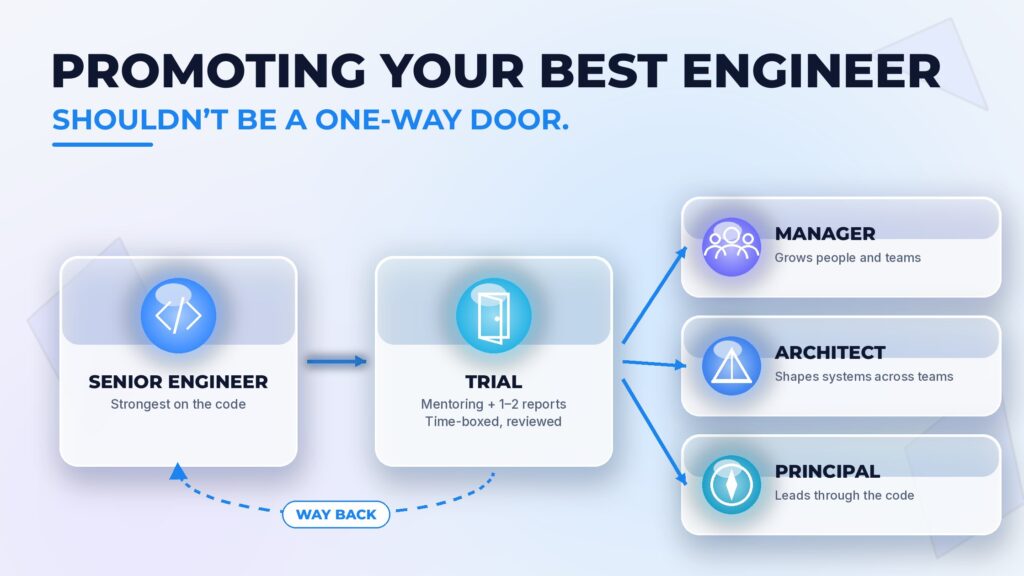
The model I have worked with gives someone at Senior or Lead Engineer level three routes: Management, Principal or Architecture. In that model, management is accountable for people and teams: their growth, wellbeing and performance. Principal is accountable for technical direction and quality, often leading through the code itself. Architecture is accountable for how systems fit together across teams, which leans heavily on influence and communication. Titles and boundaries vary between organisations. Principal engineers may spend substantial time on technical strategy and cross-team influence, while architects may remain deeply hands-on. What matters is that each route is a real step up, not a consolation prize.
Will Larson’s Staff Engineer describes several distinct shapes of senior technical leadership, and notes that some companies have no technical leadership track at all and push experienced engineers towards management. If your organisation is in that position, that is worth fixing before you fill the next management role.
Make the trial explicit and supported
A trial should not mean informal line management without clear authority. It works best as a temporary, communicated acting assignment, distinct from a permanent appointment, with everyone affected knowing what it is and when it ends.
- Mentoring is useful preparation. It shows whether someone enjoys helping other people grow and stays patient when progress is slow, but it does not reproduce the accountability of line management.
- Line management of one or two people can provide a bounded introduction, provided the person’s engineering commitments are reduced to make room for the responsibility. Choose a supported scope: a first management assignment should not be an unresolved performance crisis.
For a trial involving direct reports, agree:
- a named, experienced manager who supports the trial and remains accountable for its oversight
- clear responsibilities and decision boundaries, including what the trial manager can and cannot decide
- an explanation to affected reports of who manages them and where they can raise concerns
- support for sensitive performance or people matters
- a planned handover if the trial ends
Make the way back concrete
If going back to engineering looks like failure, people may stay in a role that isn’t right for them rather than lose face. So agree the return path before the trial starts, in plain terms:
- the engineering level the person holds before the trial
- the role they return to
- what happens to title and pay during and after the acting assignment
- who will manage the reports afterwards
A return path has to work for the team as well as the individual. It also helps to be honest about scale: stepping back after a short trial is very different from returning to engineering after years in management, which may take time to rebuild technical context. Charity Majors’ essay The Engineer/Manager Pendulum makes the broader case that moving between engineering and management over a career can make people better at both.
I would also be careful about the opposite mistake. If someone doesn’t want to manage people, thrusting line management onto them is unlikely to work for either side. A trial is for finding out, not for persuading.
What I look for
Technical strength is necessary, but it isn’t what tells me someone suits people leadership. Two things I notice are that they are not afraid to step up when a situation needs someone to, and that they stay calm in times of stress. On their own, those aren’t enough, and it is easy to over-read visible confidence or a good night in an incident. Other practical signals:
- listening before proposing a solution
- giving clear, useful feedback, and following through
- delegating without taking the work back
- helping others succeed without needing personal credit
During a trial, the most useful evidence combines feedback from the affected reports, gathered by the supporting manager, with the candidate’s own reflection.
It is also worth being honest about what the job feels like. On a challenging day of back-to-back meetings, I sometimes remember being an engineer, with a more focused set of responsibilities. But the variety of the role keeps it fresh, and I wouldn’t change it now. Someone considering the move deserves to hear both halves of that.
A trial plan with a way back
Before anyone steps into management, I would want these agreed and written down:
- The choice: the person has weighed the other senior routes and is choosing management, not defaulting to it.
- The assignment: a temporary, communicated acting role, with a named supporting manager accountable for oversight.
- The scope: mentoring, and line management of one or two people, with clear decision boundaries and no unresolved performance crisis as a first assignment.
- The time box: a start date, an end date and a review date in the diary.
- What you will look at: two or three agreed signals, with feedback from reports gathered by the supporting manager alongside the candidate’s reflection.
- Check-ins and support: a regular slot to review how it is going, and help available for sensitive people matters.
- The way back: the pre-trial level, the return role, title and pay during and after, and who manages the reports afterwards.
- Their technical work: engineering commitments reduced to make room for the trial, with what they hand over and what they keep agreed, so the team isn’t left with a gap.
Promotion is also succession
Promoting people into Lead, Principal and Advocate roles has, for me, been about continuity for the team and growth for the people in it. A dependable team matters to me, and it depends on people being ready to step into bigger roles. A secondary benefit is that it creates a path for my own backfill, so I can keep progressing too.
That only works if people are in roles that suit them. Treating the move into management as a two-way door gives your strongest engineers a real choice, and a better chance of retaining a strong colleague in work that suits them, while giving the team the leadership it needs.