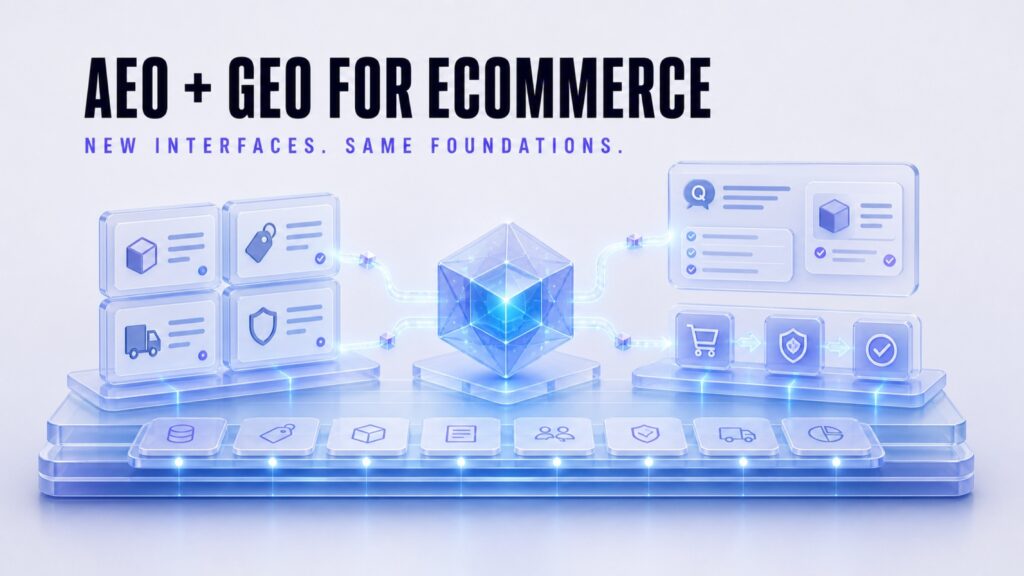
The language around search is changing again. AEO and GEO are useful shorthand for how answer engines and generative systems surface information — and agentic commerce is pushing that shift further, from answers toward actions. Ecommerce teams still need durable technical foundations. The labels are new. Much of the work that actually moves the needle is not.
What has changed: discovery interfaces now summarise, compare and increasingly act on information.
What has not: they still depend on crawlable pages, consistent product data, honest structured data and clear policies.
Why the terminology has appeared
People no longer only browse ten blue links. They ask questions in search boxes that return summarised answers, chat with assistants that cite a handful of sources, and discover brands through interfaces that feel more like conversation than a results page. Answer Engine Optimisation and Generative Engine Optimisation have emerged as names for that shift.
Those names help teams talk about discovery without pretending the old web has disappeared. They also create risk: a rush to “optimise for AI” that skips crawlability, clarity and trustworthy information. New interfaces still depend on source material they can fetch, understand and trust.
Google’s current guidance is unusually direct: there are no additional technical requirements or special optimisations needed for its AI search features. Established SEO foundations still apply.
What remains traditional SEO
Information architecture, internal linking, performance, crawl access and useful copy still matter. If product templates are thin, navigation is confusing or important policies are buried, neither classical ranking systems nor generative surfaces have much solid material to work with.
In practice, sites that already communicate entities and facts clearly — who you are, what you sell, how fulfilment and returns work, which pages are canonical — tend to be better placed as answer experiences evolve. Traditional SEO discipline is not obsolete; it is the substrate newer discovery layers sit on.
Crawlability and server-rendered content
When important product and organisational content depends entirely on client-side rendering, it may be less reliably available to some crawlers, retrieval systems and agents. Prefer server-rendered or reliably hydrated HTML for core commerce content: titles, prices, availability, specifications, shipping and returns, and the organisational facts shoppers expect to verify.
This is not an argument against modern frontend frameworks. It is an argument for treating critical commerce content as something machines — and impatient humans — can read without executing a large client bundle first. Engineering choices here are SEO choices, whether or not the ticket says so.
Entities, authorship and structured data
Consistent names for organisations, products, brands and authors help machines and people understand who is saying what. When the same entity is labelled differently across templates, feeds and schema, confidence drops — for shoppers and for systems trying to assemble a coherent answer.
Structured data should mirror visible content — not invent claims. A Product block that disagrees with the page, or an Organisation node that conflicts with the footer and About copy, creates more confusion than clarity. Clear authorship and editorial ownership become more valuable as interfaces compress several sources into one answer: be explicit about who wrote a guide, who maintains a policy, and what the organisation actually stands behind.
Product and organisational information
Clear product attributes, policies, support routes and brand identity remain high-value signals. Shoppers still need dimensions, materials, compatibility, delivery expectations and return paths. Generative interfaces can use the same complete, well-structured information — they simply present it in a different shape.
Organisational information is easy to neglect on large catalogues: registered details, contact routes, store locations, warranty language. Keeping those facts accurate and easy to find is unglamorous work. It is also the kind of work answer engines can use when someone asks whether a retailer is legitimate, how to get help, or what a brand actually sells.
AI retrieval versus model training
Retrieval-augmented experiences depend on accessible, current source material. That is different from hoping a model “remembers” a brand from training data alone. Training cut-offs, sparse mentions and contested facts make memory an unreliable growth plan.
For ecommerce teams, the practical implication is straightforward: make the site a good source. Stable URLs, fresh inventory and pricing where it matters, unambiguous product identity, and content that answers real questions will serve both classical search and systems that retrieve before they generate.
Where agentic commerce raises the stakes
Agentic commerce is the next turn of the same story: assistants that do not only answer questions, but compare options, check constraints, and in some flows initiate purchase or service actions on someone’s behalf. That moves the requirement from “be findable in a summary” to “be usable as a reliable source of truth for a task.”
Protocols such as OpenAI’s Agentic Commerce Protocol (announced with Instant Checkout), Google’s Universal Commerce Protocol, and Agent Payments Protocol show the direction of travel, but support, availability and adoption still vary considerably by platform and market.
OpenAI has since expanded ACP towards richer product discovery, allowing merchants to retain their own checkout experiences and focusing its efforts on product discovery. That evolution does not abandon the protocol — it reinforces the practical point for ecommerce teams: platform implementations move quickly, while complete, current and machine-usable product data remains the durable investment.
Agents amplify weaknesses that a human shopper might work around. Ambiguous SKUs, stale stock, policy pages that disagree with checkout, and attributes that only exist in a JavaScript drawer become failures in an automated path. The same foundations that help AEO and GEO — crawlable facts, consistent entities, honest structured data — become harder requirements when software is acting, not only reading.
You do not need a speculative roadmap to respond. Treat machine-usable product and policy data as a first-class engineering concern: clear identity, live availability where it matters, explicit constraints, and organisational trust signals that do not contradict the storefront.
What schema can and cannot do
Schema clarifies. It does not compensate for thin pages, blocked crawlers or contradictory on-page information. Markup helps machines parse what is already true and visible; it is not a shortcut past quality, nor a substitute for fixing template-level content gaps.
Invest in schema where it matches real commerce objects — products, organisations, FAQs that genuinely appear on the page, articles with real authors. Skip decorative markup that exists only to “feed the AI.”
Superficial GEO tactics to avoid
Keyword stuffing for chatbots, fabricated FAQs and unsupported authority claims create risk without durable benefit. So do doorway pages written for machines first, scraped “expert” content with no editorial ownership, and metrics that celebrate model mentions without tying them to revenue, trust or support outcomes.
Judgment still applies. If a tactic would look manipulative to a careful human reader, it is unlikely to age well as discovery interfaces — or agentic shopping paths — change.
A practical ecommerce checklist
- Confirm critical templates are crawlable and expose core facts in HTML
- Keep product and organisation facts consistent across page, feed and schema
- Keep product feeds and merchant-platform data current alongside storefront pages
- Align structured data with visible content — nothing invented
- Treat availability, constraints and identity as machine-usable inputs for agentic flows, not only for human PDPs
- Improve page experience and content quality on money and trust templates
- Measure carefully; avoid vanity GEO metrics that ignore commercial outcomes
Final conclusions
AEO and GEO describe a shift in discovery interfaces; agentic commerce describes what happens when those interfaces start to act. For ecommerce teams, the practical response is still clarity, accessibility, trustworthy information and strong engineering craft. Learn the new vocabulary — then spend most of your energy on the foundations that make any discovery or agent surface work.
Sources and further reading
Primary documentation worth reading alongside this piece:
- Google Search Central — AI features and your website
- Google Search Central — A new resource for optimising for generative AI
- Google Search Central — Introduction to structured data
- Google Search Central — Product structured data
- Google Search Central — Organization structured data
- OpenAI — Agentic Commerce Protocol and Instant Checkout
- OpenAI — Powering product discovery in ChatGPT
- Google Developers — Universal Commerce Protocol
- Schema.org — Product and Organization
- W3C — Web Content Accessibility Guidelines (WCAG) overview